

High oleic sunflower oil is a sunflower oil made from specially bred varieties whose seeds contain at least 75% oleic acid, compared with roughly 15–40% in conventional sunflower oil. That shift in its fatty acid profile makes it far more stable under heat and far more resistant to oxidation, which is why it has become one of the go-to oils for the food, cosmetics and pharmaceutical industries.
At Green Crops we work with sunflower from the field onwards: we buy the seed directly from farmers in Andalusia, press it at our plant in Monturque (Córdoba, Spain) and, when a customer needs it, refine it. In this guide we explain what high oleic sunflower oil actually is, how it differs from standard sunflower oil, whether it is good or bad for you, and how it is used in industry.
What is high oleic sunflower oil?
Sunflower oil is one of the most widely used vegetable oils in Europe, but not all sunflower oil is the same. Depending on the type of seed, there are three main kinds: conventional (also called linoleic), mid oleic and high oleic. All three come from the same plant, Helianthus annuus. What changes is the balance of fatty acids stored in the seed.
What does “high oleic” mean?
Oleic acid is a monounsaturated fatty acid (omega-9). It is the same fatty acid that dominates olive oil. When an oil is described as “high oleic”, it means oleic acid is by far its main fatty acid. The international Codex Alimentarius standard for named vegetable oils (CXS 210-1999) sets the oleic acid content of high oleic sunflower oil at between 75% and 90.7%. In practice, most commercial high oleic oils sit between 80% and 90%.
The flip side is linoleic acid (omega-6), a polyunsaturated fatty acid that dominates conventional sunflower oil. Polyunsaturated fats have more double bonds and oxidise much more easily. So the less linoleic acid and the more oleic acid an oil contains, the more stable it is.
How it is produced: selected seeds, not GM crops
The difference lies in the seed, not in the extraction process. High oleic sunflower comes from varieties developed through plant breeding. The first, known as Pervenets, was developed in the former Soviet Union in the 1970s. Since then, conventional breeding (crossing and selection) has carried the trait into the hybrids farmers sow today. It is not a genetically modified crop.
For the farmer, growing high oleic sunflower is much like growing the conventional crop: the same sowing dates, the same growing cycle and the same harvest. The key is keeping it separate. Cross-pollination or mixing with conventional grain at intake will lower the oleic content of a batch, which is why traceability from sowing onwards matters so much with this crop. In Andalusia, high oleic varieties now account for around three quarters of the sunflower area, as we explained in our article on the 2026 sunflower harvest in Andalusia.
High oleic sunflower oil vs sunflower oil: the key differences
At first glance, a refined conventional sunflower oil and a refined high oleic one look almost identical: the same pale colour and the same neutral flavour. The difference shows up in the laboratory and, above all, in the fryer.
| Conventional sunflower oil (linoleic) | High oleic sunflower oil | |
|---|---|---|
| Oleic acid (omega-9) | 14–39% | 75–91% |
| Linoleic acid (omega-6) | 48–74% | 2–17% |
| Saturated fat | Low, around 10% | Low, around 10% |
| Oxidative stability | Moderate | Very high, several times greater |
| Performance in frying | Breaks down sooner with continuous use | Lasts longer and withstands more frying cycles |
| Shelf life | Shorter | Longer |
| Typical uses | Home cooking, dressings, sauces | Industrial frying, crisps and snacks, bakery, cosmetics, pharmaceuticals |
Reference ranges from Codex standard CXS 210-1999. Values for each batch are set out in its technical data sheet, available in our catalogue.
What about mid oleic sunflower oil?
Between the two sits mid oleic sunflower oil, with 43–72% oleic acid. It strikes a balance between stability and nutritional profile and is widely used in the United States, but it is less common in Europe, where the food industry has clearly opted for high oleic.
Is high oleic sunflower oil healthy?
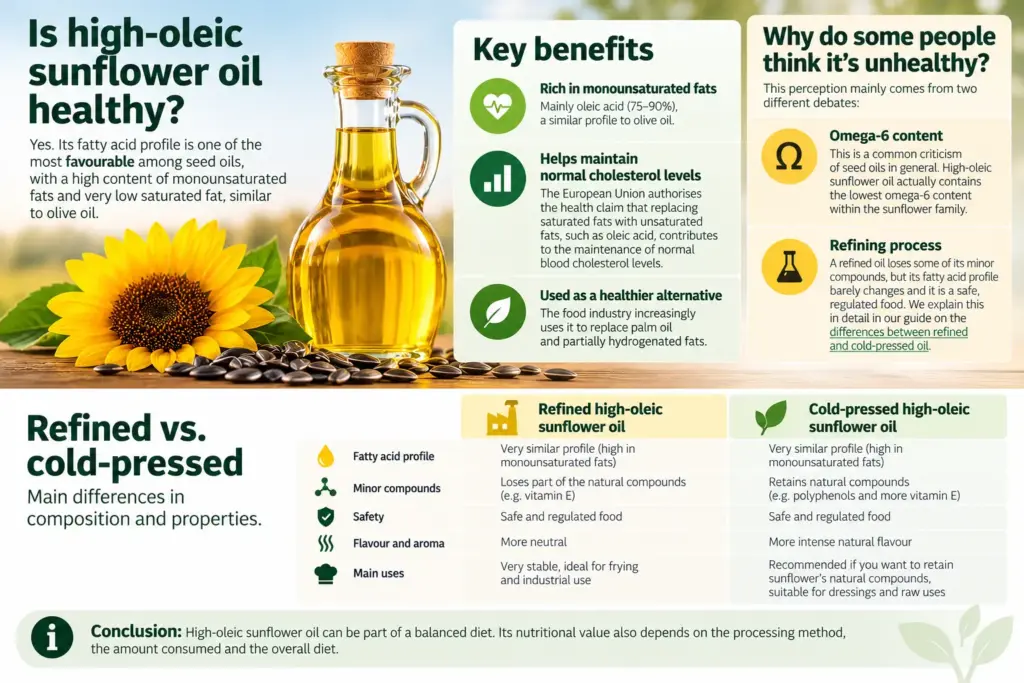
It is one of the most frequently asked questions, and the short answer is that its fat profile is among the most favourable of all seed oils. It is made up mostly of monounsaturated fat, with very little saturated fat, a profile similar to that of olive oil. Both the EU and the UK authorise the health claim that replacing saturated fats in the diet with unsaturated fats, such as oleic acid, contributes to the maintenance of normal blood cholesterol levels. That is one reason why food manufacturers increasingly use it to replace palm oil and partially hydrogenated fats.
So where does the idea that high oleic sunflower oil is bad for you come from? Mainly from two separate debates:
- Too much omega-6 in the diet. This criticism is usually aimed at seed oils in general. High oleic sunflower oil, however, contains less omega-6 than any other type of sunflower oil.
- The reputation of refined oils. Refining removes some minor compounds, but the fatty acid profile barely changes, and refined oil is a safe, regulated food. We cover this in detail in our guide to refined vs cold-pressed oil.
What is true is that refined high oleic sunflower oil does not provide the polyphenols found in extra virgin olive oil, and that refining reduces some of its natural vitamin E. If you want to keep those compounds, cold-pressed oil is the better choice.
This content is for information only and is not a substitute for advice from a doctor or registered dietitian.
High oleic sunflower oil vs olive oil
Olive oil contains between 55% and 83% oleic acid, so a good high oleic sunflower oil can match or even exceed it on this fatty acid. The differences lie elsewhere:
- Flavour: virgin olive oil has a strong, distinctive taste. Refined high oleic sunflower oil is neutral and does not affect the flavour of the finished product.
- Minor compounds: extra virgin olive oil provides polyphenols that sunflower oil does not.
- Availability and cost: high oleic sunflower oil is produced in large volumes, with very consistent quality and usually at a lower cost, which is a decisive factor for manufacturers.
That is why, for industrial applications that need a neutral flavour and high stability, high oleic sunflower oil is usually the first choice.
Refined or cold-pressed high oleic sunflower oil?
High oleic sunflower oil is available in both versions, and each meets different needs:
- Cold-pressed (virgin). Extracted by mechanical pressure alone, without solvents. It keeps its golden colour, nutty sunflower-seed flavour and more of its vitamin E. It is the preferred option for dressings, premium food products and natural cosmetics. See our cold-pressed oils.
- Refined. Purified through degumming, neutralisation, bleaching, deodorisation and winterisation, which leaves it neutral, clear and highly consistent from batch to batch. Refined high oleic sunflower oil is the standard for industrial frying, processed foods and pharmaceuticals. See our refined oils.
Combining the high oleic trait with refining produces one of the most stable vegetable oils available, without giving up a favourable fat profile. At Green Crops we cold-press sunflower at our Monturque plant and refine mainly organic sunflower oil, keeping its organic certification throughout the process.
Industrial uses of high oleic sunflower oil
Food industry: an oil built for frying
Frying is its main application. Because it contains so little linoleic acid, high oleic sunflower oil breaks down far more slowly than conventional sunflower oil: it forms fewer oxidation compounds, extends the life of the frying oil and reduces how often the oil needs changing. It is used in:
- Crisps, snacks and fried nuts.
- Ready meals and continuous industrial frying.
- Biscuits, bakery and pastry, as an alternative to palm oil.
- Sauces, foods preserved in oil and coatings for cereals and nuts, where its stability extends product shelf life.
Find out more about our solutions for the food industry.
Cosmetics and soap making
In cosmetics, high oleic sunflower oil is a light, well-tolerated emollient and, above all, a stable one. Because it is less prone to going rancid, it extends the shelf life of creams, lip balms, body oils and hair care products, and reduces the need for added antioxidants. Soap makers also favour it: high oleic oil is much less likely to cause the orange spots associated with rancidity in finished bars. In its cold-pressed organic form, it suits natural and certified organic formulations; the refined version is used when a formula needs an oil with no odour or colour. Explore our oils for the cosmetics sector.
Pharmaceuticals and nutraceuticals
Refined vegetable oils are used as excipients and carriers in soft capsules, ointments and other formulations, where stability and batch-to-batch consistency are essential. At Green Crops we produce refined oil to European Pharmacopoeia (Ph. Eur.) specification. More details on our pharmaceutical sector page.
Other industrial uses
Its resistance to oxidation also makes it a useful base for biodegradable lubricants and other oleochemical products, a growing field as industry looks for alternatives to petroleum-based ingredients.
Organic high oleic sunflower grown in Andalusia
Andalusia is one of Spain’s main sunflower-growing regions, and in recent years high oleic has become the dominant type in its dryland fields. At Green Crops we work directly with organic farmers across the region. Every seed lot is identified from sowing, so we can trace the exact origin of each batch of oil that leaves our plant.
What’s more, at Green Crops we produce organic high oleic sunflower oil from certified seed grown by Andalusian farmers we work with directly. We make it at our Monturque plant in both cold-pressed and refined form, keeping its organic certification and full batch traceability from field to dispatch. The result combines the stability of high oleic oil with the guaranteed origin of an organic crop, a pairing increasingly sought after by food, cosmetics and pharmaceutical manufacturers looking for clean, stable ingredients with verifiable provenance.
Our plant in Monturque (Córdoba) brings together intake, cleaning, pressing, storage and dispatch, with a crushing capacity of 20,000 tonnes and an 8,000 m² storage warehouse. From here we export vegetable oils and proteins to more than 25 countries.
Depending on the product and destination, our oils hold certifications including:
- EU organic production, certified by CAAE.
- USDA Organic, for the US market.
- COSMOS, for organic cosmetic ingredients.
- Kosher (KLBD).
- BRC certification for food safety.
We supply oil in bulk in flexitanks, 200 kg drums, 1,000 L IBCs, tankers and isotanks, depending on order volume and destination.
Frequently asked questions
Is high oleic sunflower oil genetically modified?
No. High oleic varieties were developed through conventional plant breeding, starting from a line obtained in the 1970s. They are not genetically modified organisms.
How much oleic acid does high oleic sunflower oil contain?
Under the Codex standard, between 75% and 90.7%. Commercial oils usually contain between 80% and 90%. Conventional sunflower oil contains between 14% and 39%.
Is high oleic sunflower oil good for frying?
Yes. It is one of the best seed oils for frying, especially in refined form, because it copes well with normal frying temperatures (160–180°C) and breaks down more slowly than conventional sunflower oil.
How can I tell if my sunflower oil is high oleic?
You cannot tell by looking at it. Check the label or the product’s technical data sheet, which should state the fatty acid profile. In industry, each batch is checked by gas chromatography analysis.
Is high oleic sunflower oil better than regular sunflower oil?
For high-temperature cooking and for any product that needs a long shelf life, yes: it is more stable and contains less omega-6. For cold uses, both are valid options.
Where can I buy high oleic sunflower oil in bulk?
If you need sunflower oil for industrial use, Green Crops produces organic high oleic sunflower oil, both cold-pressed and refined, at our plant in Córdoba, Spain, and supplies it in bulk formats to customers in more than 25 countries. Get in touch for availability, specifications and samples.
Looking for an organic high oleic sunflower oil supplier?
We control the whole journey, from the seed our Andalusian farmers sow to packing and dispatch. If you are looking for an organic sunflower oil supplier with full traceability, browse our range of organic vegetable oils, download the catalogue with technical data sheets or speak to our team.
Want to learn about other oils in our range? Read our guides to safflower oil and organic rapeseed oil.