

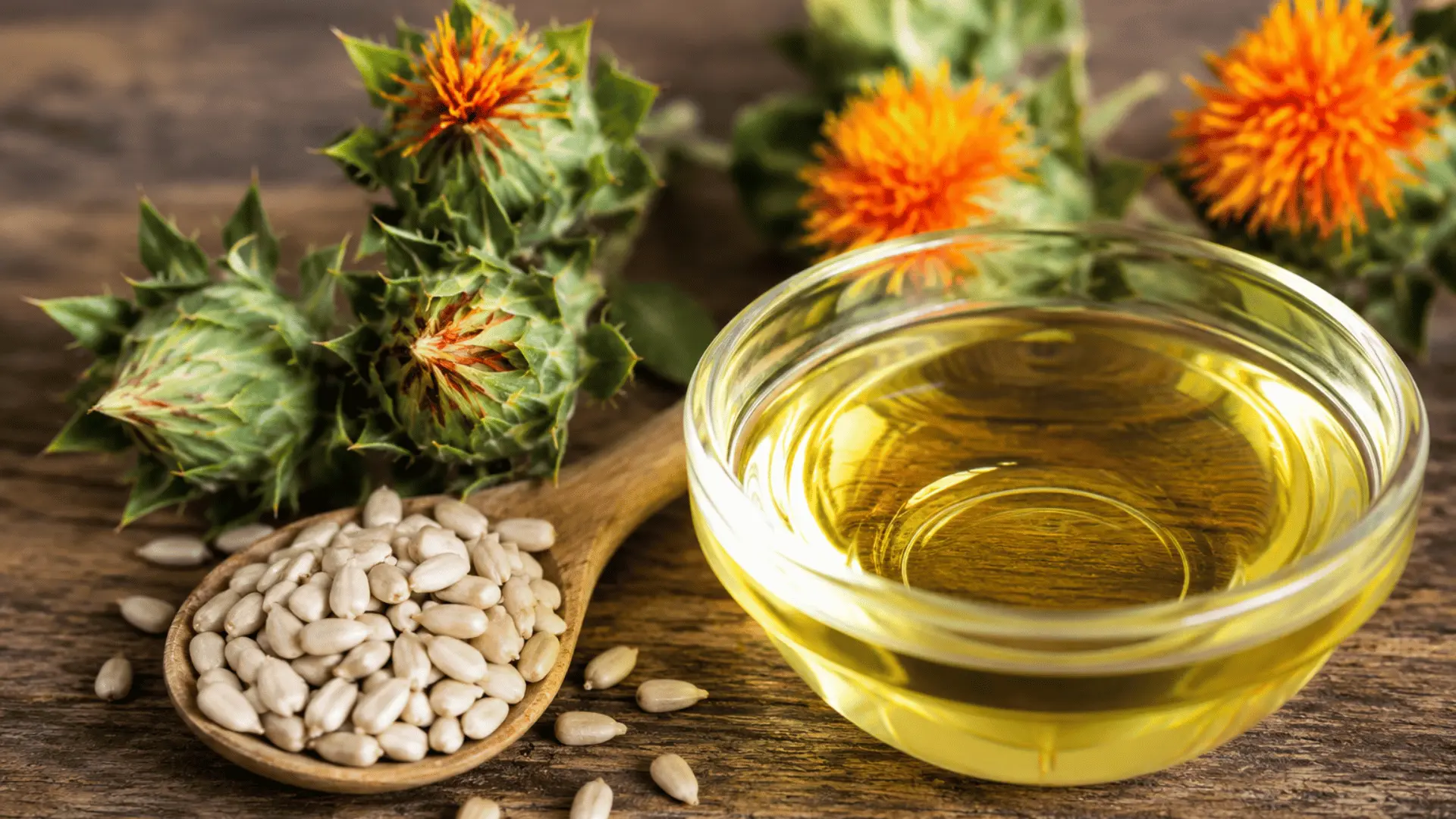
Safflower oil is one of those vegetable oils that, despite having been part of Mediterranean agricultural culture for centuries, remains largely unknown to the general public. It is extracted from the seeds of Carthamus tinctorius, a thistle-like plant already used by the Greeks and Egyptians, originally as a source of dye and, later, as the raw material for an oil with a highly interesting nutritional profile. In this post, “Safflower Oil: Properties and Uses”, we explain why this crop is gaining prominence in the food, cosmetics and pharmaceutical sectors.
What is safflower oil?
Safflower is an annual oilseed plant, highly resistant to drought and well suited to hot, dry climates, which makes it a particularly interesting crop for Mediterranean farming and for crop rotation models. Its seeds yield a golden-yellow oil with a mild flavour, available in two main varieties: one rich in linoleic acid (omega-6, polyunsaturated) and one rich in oleic acid (omega-9, monounsaturated), the latter known as high-oleic safflower oil. You can discover the rest of our range of organic vegetable oils at Green Crops.
Nutritional profile of safflower oil
The fatty acid composition is what sets the two varieties apart. High-oleic safflower oil can reach up to 80% oleic acid, the same monounsaturated fatty acid found in olive oil, together with a smaller proportion of linoleic acid (omega-6) and linolenic acid (omega-3), plus small amounts of saturated fatty acids such as palmitic and stearic acid. This richness in monounsaturated fats also gives it notable resistance to oxidation and a high smoke point, close to 265°C, making it particularly well suited to high-temperature cooking. Safflower oil is also a notable source of vitamin E, a powerful natural antioxidant. At Green Crops we work with both the cold-pressed and refined varieties, depending on each client’s needs.
Health benefits of safflower oil
Thanks to its high oleic acid content, high-oleic safflower oil is traditionally associated with a heart-healthy profile, as this type of monounsaturated fat helps maintain balanced cholesterol levels. Its vitamin E content further strengthens its antioxidant role, helping protect cells against oxidative stress. Because of its unsaturated fatty acid composition, it is commonly used as an alternative to other cooking oils, including sunflower or soybean oil, especially in dishes that require cooking at high temperatures.
It’s worth remembering that, as with any vegetable oil, consumption should be moderate as part of a varied and balanced diet, and that the safflower variety intended for raw consumption is not always suitable for cooking, so it’s worth checking the product label before using it in the kitchen.
Uses in cosmetics and skincare
Beyond the kitchen, safflower oil has a long history in natural cosmetics. Its high content of essential fatty acids makes it a highly valued ingredient for moisturising dry or irritation-prone skin, thanks to its ability to absorb quickly without leaving a greasy feel. The linoleic acid in the oil helps maintain the skin barrier and is associated with improved skin texture and radiance, while its vitamin E content provides an additional antioxidant effect. For these reasons, it is commonly found as an ingredient in serums, body oils and hair formulations, where it is credited with strengthening the scalp and adding shine. If you’re looking for a raw material for your brand, at Green Crops we supply organic safflower oil for the cosmetics sector.
Industrial applications of safflower
The uses of safflower go beyond edible or cosmetic oil. Its saponifiable content means it can be used in the manufacture of soaps, detergents and shampoos, and its versatility as a raw material positions it as a crop of growing interest for both the food industry and the pharmaceutical industry, two of the sectors where Green Crops focuses much of its activity.
Green Crops’ organic safflower oil
At Green Crops we work with suppliers and farmers committed to organic farming to offer a safflower oil obtained through careful pressing processes that preserve its nutritional properties as much as possible. Our goal is to support the entire process, from cultivation to the finished product, guaranteeing the traceability and quality demanded by the food, cosmetics and pharmaceutical sectors alike.
If you’re a farmer growing safflower, or considering adding it to your crop rotation, we invite you to find out how to become a Green Crops supplier. And if you represent a company in the food, cosmetics or pharmaceutical sector and are looking for a quality organic safflower oil, don’t hesitate to get in touch with us.
Safflower oil is a good example of how a traditional crop can be reinvented thanks to agronomic research and growing demand for natural, sustainable ingredients. Its fatty acid profile, heat stability and versatility of uses — from the kitchen to cosmetics and industry — make it a raw material with great potential. At Green Crops we remain committed to this type of crop, offering our clients organic, quality solutions.