

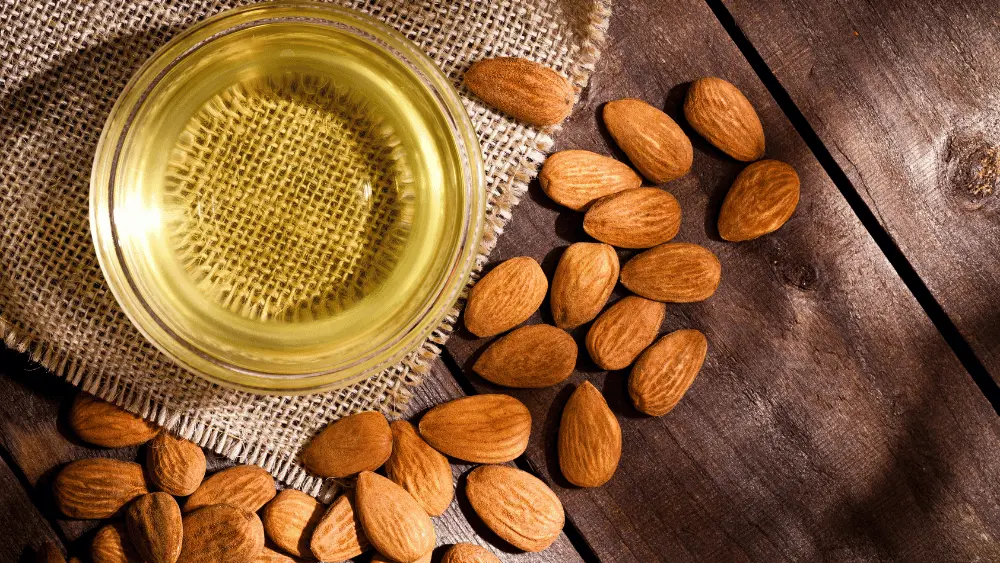
Sweet almond oil is a vegetable oil extracted from the kernels of the sweet almond (Prunus dulcis). It stands out for its high oleic acid content, soft feel and easy spreadability on the skin. As a result, it is one of the most widely used ingredients in cosmetics, and it also has applications in food and pharmaceuticals.
At Green Crops, we press almonds at our plant in Monturque (Córdoba, Spain). In fact, almond is the raw material our customers request most for body oils, lotions and moisturising products. This guide explains its properties, what it is used for, its drawbacks and how to choose the right grade.
What is sweet almond oil?
This oil comes from the kernels of the sweet variety of the almond tree. It is obtained by mechanical pressing and, depending on its end use, sold either cold-pressed or refined. On cosmetic data sheets, it appears under the INCI name Prunus Amygdalus Dulcis Oil.
Its colour ranges from pale yellow to golden. In addition, the pressed oil keeps a mild, slightly nutty aroma.
Sweet almonds and bitter almonds: the difference
It should not be confused with bitter almond oil. Bitter almonds contain amygdalin, a compound that releases hydrogen cyanide as it breaks down. For this reason, crude bitter almond oil is not used directly in food or cosmetics.
Sweet almonds, on the other hand, contain only minimal amounts of this substance. To tell them apart, simply check the botanical variety on the technical data sheet: dulcis means sweet and amara means bitter.
Properties of sweet almond oil
Its composition explains much of its behaviour. As a review published in Grasas y Aceites notes, almond oil is low in saturated fatty acids and dominated by oleic acid. These are the usual ranges in specifications for refined oil that follows the European Pharmacopoeia:
| Fatty acid | Typical range |
|---|---|
| Oleic acid (C18:1) | 62–86% |
| Linoleic acid (C18:2) | 20–30% |
| Palmitic acid (C16:0) | 4–9% |
| Linolenic acid (C18:3) | 0.4% maximum |
The oil also provides tocopherols (vitamin E) and phytosterols. These compounds are better preserved in cold-pressed oil, because refining removes some of them. Likewise, its low linolenic acid content supports stability against oxidation. Even so, it is best kept somewhere cool and away from light.
Benefits for skin
Its main cosmetic function is as an emollient: it softens the skin and improves its feel. A 2010 scientific review covers its traditional uses and highlights these emollient properties. However, the same review points out that conclusive data on many of its effects is still lacking.
What is sweet almond oil used for?
Its balanced profile and light texture make it suitable for very different sectors.
Cosmetics and personal care
This is its main field of application. Formulators add it to the oil phase of creams, serums, lotions and lip balms. It is also used neat as a massage or body oil, since it spreads easily.
In hair care, it features in masks and conditioners because it adds softness and shine. If you formulate cosmetic products, see what we offer the cosmetics sector.
Food
Food-grade oil has a delicate flavour that works well in dressings, baking and gourmet products. It is also an ingredient option for food manufacturers looking for a simple label.
Pharmaceuticals
In this sector, it is mainly used as an excipient. This use calls for a refined oil that meets the European Pharmacopoeia (Ph. Eur.) parameters, a specification we can also produce for the pharmaceutical sector.
Drawbacks of sweet almond oil
Although it is generally well tolerated, this ingredient does have some limitations:
- Tree nut allergy. Almonds must be declared as an allergen on food labels in the EU and the UK. Therefore, people with this allergy should avoid the oil.
- Acne-prone skin. It is usually given a comedogenic rating of 2 out of 5, an indicative figure that suggests trying it with care.
- Damaged skin barrier. Oils rich in oleic acid are not always the best option here. Oils higher in linoleic acid are often preferred instead.
- Storage. Like any vegetable oil, it turns rancid if exposed to light, heat or air for long periods.
Cold-pressed or refined sweet almond oil?
The choice depends on the final application. For more detail, read our guide to refined vs. cold-pressed oil. For almond, the main differences are these:
| Criterion | Cold-pressed | Refined |
|---|---|---|
| Process | Mechanical pressing at a controlled temperature, with no solvents | Pressing followed by RBDW refining |
| Colour and aroma | Golden yellow, slightly nutty aroma | Paler, with a neutral odour |
| Origin at Green Crops | Organic or conventional, subject to availability | Mainly conventional |
| Typical use | Natural cosmetics and food | Neutral formulations and pharmaceuticals |
You can browse the full range on our cold-pressed oils and refined oils pages.
What to check when buying this oil for industrial use
Before approving a supplier, it pays to check several points:
- Product grade: cosmetic, food or Ph. Eur., depending on the application.
- Batch certificate of analysis: acidity, peroxide value and fatty acid profile.
- Traceability: almond origin and control at each stage of the process.
- Certifications: organic production or COSMOS, if the formulation requires them.
- Format and logistics: packaging suited to the volume and destination.
Sweet almond oil from Green Crops
Our Monturque plant combines intake, cleaning, pressing, storage and dispatch on one site. Thanks to this, we maintain batch traceability from origin through to packaging. From here, we export vegetable oils and proteins to more than 25 countries.
Depending on the product and destination, our oils hold the following certifications:
- European Union organic production, certified by CAAE.
- USDA Organic, for the US market.
- COSMOS, for organic cosmetic ingredients.
- Kosher (KLBD).
- BRC certification for food safety.
We supply the oil in flexitanks, 200 kg drums, 1,000-litre IBCs, tankers, isotanks and in bulk. Do you need a sample or a technical data sheet? Take a look at our catalogue or talk to our team.
If you are comparing raw materials, you may also like our guide to safflower oil.
Frequently asked questions
Is there a difference between almond oil and sweet almond oil?
In practice, they are usually the same product. When a label simply says “almond oil”, it normally refers to the sweet variety. Even so, it is worth confirming the botanical name.
Can you put sweet almond oil directly on skin?
Yes, cosmetic-grade oil is often used neat. However, it is advisable to test it on a small area first, and anyone with a tree nut allergy should not use it.
Is it good for hair?
It is used to soften hair and add shine, especially on dry hair. That is why it appears in many hair masks and treatments.
Can you cook with sweet almond oil?
Only if it is food grade. It works best in dressings and gentle cooking, where its flavour comes through. Cosmetic-grade oil, by contrast, is not intended for consumption.